How MCP Versions Are Dated and Negotiated During Initialization
- Published
- Checked
- Sources
- 5 listed
- In short
- 3 key points
- By
- DevDiffs
MCP version strings take the form YYYY-MM-DD, and the date marks the last date backwards incompatible changes were made. During initialization, the server replies with the client’s requested version if it supports that version, or with another version it supports. Official documentation lists 2026-07-28 as the current protocol version.
In short3 key points
Key points
- Send an initialize request with a protocol version you support, ideally the latest one you support.
- On a version mismatch, pick a mutually supported version from the server's list and retry, or show an error if none fits.
- Remember that the 2026-07-28 revision removed the initialization handshake, so modern and legacy versions negotiate differently.
Full article: about 3 minutes
What the date in an MCP version means
MCP writes each version as a string in the form YYYY-MM-DD. The date marks the last date that backwards incompatible changes were made.
Why the project chose dates over semantic version numbers is not explained in the sources.
Whether a backwards compatible change receives a new version string is not stated in the sources.
How client and server agree on a version during initialization
Initialization must come first in the exchange between client and server.
- Send a protocol version your client supports in the initialize request. Ideally, use the latest version the client supports.
- When the server supports that version, it replies with the same version.
- Otherwise, the server replies with another version it supports.
- Send no requests other than pings until the server has replied to initialize.
- Disconnect when your client does not support the version in the server’s reply.
Both client and server must respect the negotiated version.
What happens when the versions do not match
A server that does not implement the requested version must reply with an UnsupportedProtocolVersionError. That error lists the versions the server does support.
Your client should then choose a mutually supported version from that list and retry. If no compatible version exists, the client should surface an error to the user.
A server that supports only modern versions should name its supported versions in any error it returns to an initialize request, on any transport.
The sources do not show an example of this error response.
How the version reaches later requests
Each request carries its protocol version in its _meta field, under the key io.modelcontextprotocol/protocolVersion. The server judges each request on its own.
Over Streamable HTTP, the same version value also goes in the MCP-Protocol-Version header.
The site lists Streamable HTTP transport as replacing HTTP+SSE.
The sources do not say which revision introduced Streamable HTTP, so this article does not place it on the timeline.
Which revisions are listed and what status each has
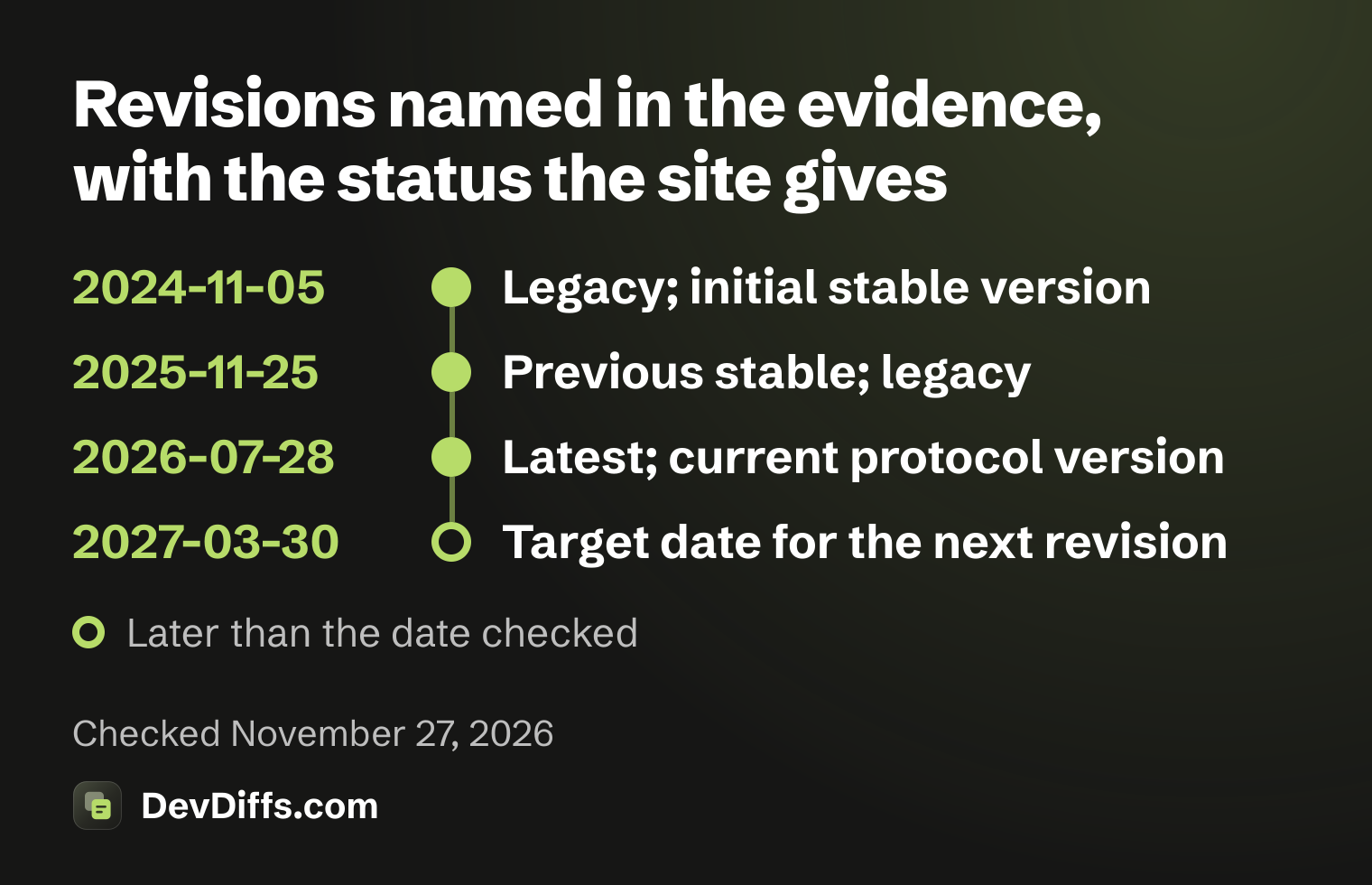
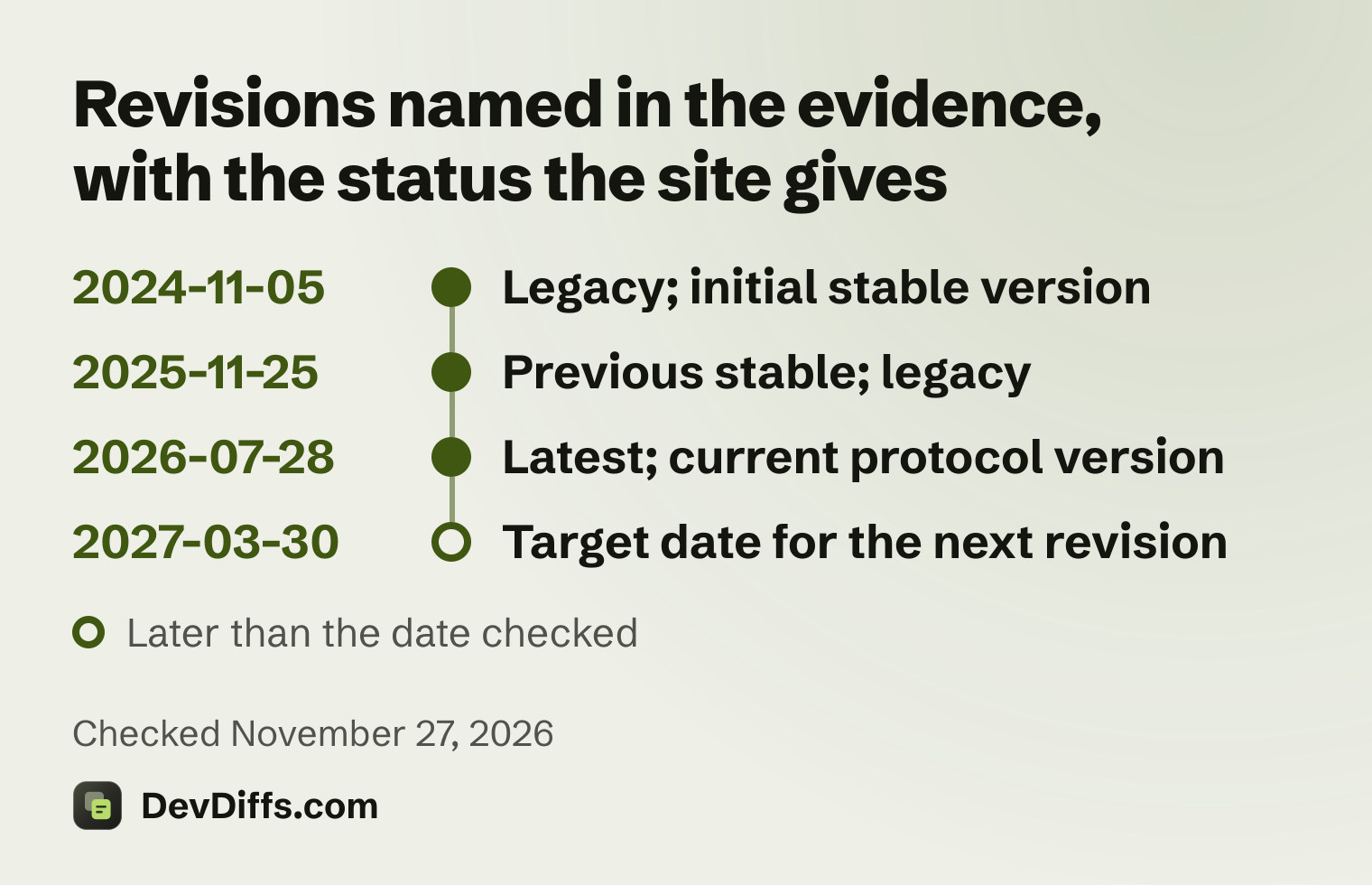
Official documentation lists 2026-07-28 as the current protocol version. A secondary source names 2025-11-25 as current, so the sources disagree. This article follows the official site.
| Revision | Status on the site | Handshake and notes |
|---|---|---|
| 2024-11-05 | Legacy; initial stable version | Legacy revisions establish a session with an initialize handshake. |
| 2025-11-25 | Previous stable; legacy | Legacy revision that uses the initialize handshake. |
| 2026-07-28 | Latest; current protocol version | Modern revision. Protocol-level sessions and the initialization handshake were removed. |
| 2027-03-30 | Target date for the next revision | Listed as the target for the next specification revision, not as a published revision. |
Revisions may be marked Draft, Current, or Final. Draft means in-progress and not yet ready for consumption. Current means the version is ready for use and may still receive backwards compatible changes. Final means past and complete, and it will not change.
The sources have no changelog for each revision, so this article does not list the protocol changes made in each one.
Supporting more than one revision
Servers must implement server/discover. Clients may call it before sending other requests but are not required to.
Under the policy, a feature stays in the specification for at least twelve months, or at least ninety days under the expedited-removal exception, before it can be removed.
The sources do not include SDK release notes, so they do not show which revisions each SDK supports.
Sources
- Lifecycle - Model Context Protocol Model Context Protocol, primary source. Accessed November 26, 2026.
- Versioning - Model Context Protocol Scribd. Accessed November 26, 2026.
- Versioning - Model Context Protocol Model Context Protocol, primary source. Accessed November 26, 2026.
- Versioning and Compatibility - Model Context Protocol Model Context Protocol, primary source. Accessed November 26, 2026.
- Model Context Protocol Specification modelcontextprotocol.info. Accessed November 26, 2026.